My empire in Heroes of Might and Magic 3 Remake collapses with all the grace of a dizzy donkey tumbling down a mountainside. Like many of history’s greatest civilizations, the cause of its downfall is a tale as old as time itself: a necromancer commanding five ghost dragons descending upon my defenseless cities. In my defense, this marks my first genuine foray into the legendary Heroes of Might and Magic 3—I was merely two years old when the original game launched in 1999, captivating millions of strategy enthusiasts worldwide. My interest in this highly anticipated remake lies less in nostalgic authenticity and more in how it measures up against my usual rotation of strategy games, including Total War: Warhammer 3, XCOM, and virtually any other turn-based tactical experience I can get my hands on. The remarkable news is that Heroes of Might and Magic 3 Remake slips into that prestigious pantheon like an overqualified deity taking its rightful throne. Just a few hours with the game, including a brief story-driven prologue and an expansive sandbox-style match on the reimagined map Arrogance 2026, proves enough to convince me that my two-year-old self should have been mastering this masterpiece from day one.
A Hero’s Welcome to a Legendary Strategy Experience
The original Heroes of Might and Magic 3, developed by New World Computing and published by 3DO Company, launched on February 28, 1999, and quickly became one of the most beloved turn-based strategy games ever created. Its impact on the genre cannot be overstated—the game sold millions of copies worldwide and spawned a dedicated community that continues creating custom maps and modifications to this day, over 25 years later. The title perfected a formula that balanced city building, resource management, hero development, and tactical combat in ways that few games have successfully replicated since. Your time in Heroes of Might and Magic 3 Remake is divided between exploring an overworld map, where each turn represents a single day, and engaging rival heroes and their armies in turn-based hexagonal combat. Cities can be conquered throughout your campaign, securing their valuable resources and allowing you to recruit from their unique denizen pools—a fiery hovel deep underground makes for an excellent source of demonic warriors, for example, while a tower perched high in the mountains can be repurposed to churn out powerful golems and other magical constructs.
Building a formidable army requires patience and strategic planning. Recruitment buildings constructed within your cities determine which fighters—and how many—are drawn to your banner each week. This proves to be a brilliantly designed feature for both game balance and immersion, as it means you cannot simply snap your fingers to instantly replenish troops after suffering casualties in a close battle. When the rival hero Thorgrim lands a formidable army on my shores, threatening my coastal territories, I march my biggest assembled blob of pikemen, archers, and majestic griffins to intercept him. The ensuing battle transforms into an absolute slugfest, and although I emerge victorious, my surviving forces are left tattered and bloodied. In retrospect, I suspect I should have exercised more patience and waited for a bigger numerical advantage before picking such a costly fight.
Accessible Systems with Remarkable Depth
My only prior experience with the HoMM franchise involved dabbling in Heroes of Might and Magic: Olden Era for approximately an hour, but the series’ core systems prove remarkably straightforward to pick up for newcomers. Clear attack and movement indicators make positioning easy to understand, and my evolving tactics boil down to bogging melee foes down with sturdy pikemen while my archers and fast-flying Archangels systematically cut down enemy backlines. The game employs a clever stacking mechanic where multiple units can be combined into one powerful group, which is reflected in their collective health and damage output. One hex can hold hundreds of pikemen that attack as one cohesive, devastating force, but with their low individual health pools, an attack from something as fearsome as a ghost dragon can kill tens of soldiers in a single devastating swoop. Conversely, bigger units like the aforementioned ghost dragons are substantially hardier, requiring focused fire from multiple sources to bring down. When I finally amass enough troops to march on Thorgrim’s imposing tower across the sea, killing just one of his massive Titans requires using my hero to sling powerful lightning spells while siege engines and archers pelt the construct relentlessly with arrows.
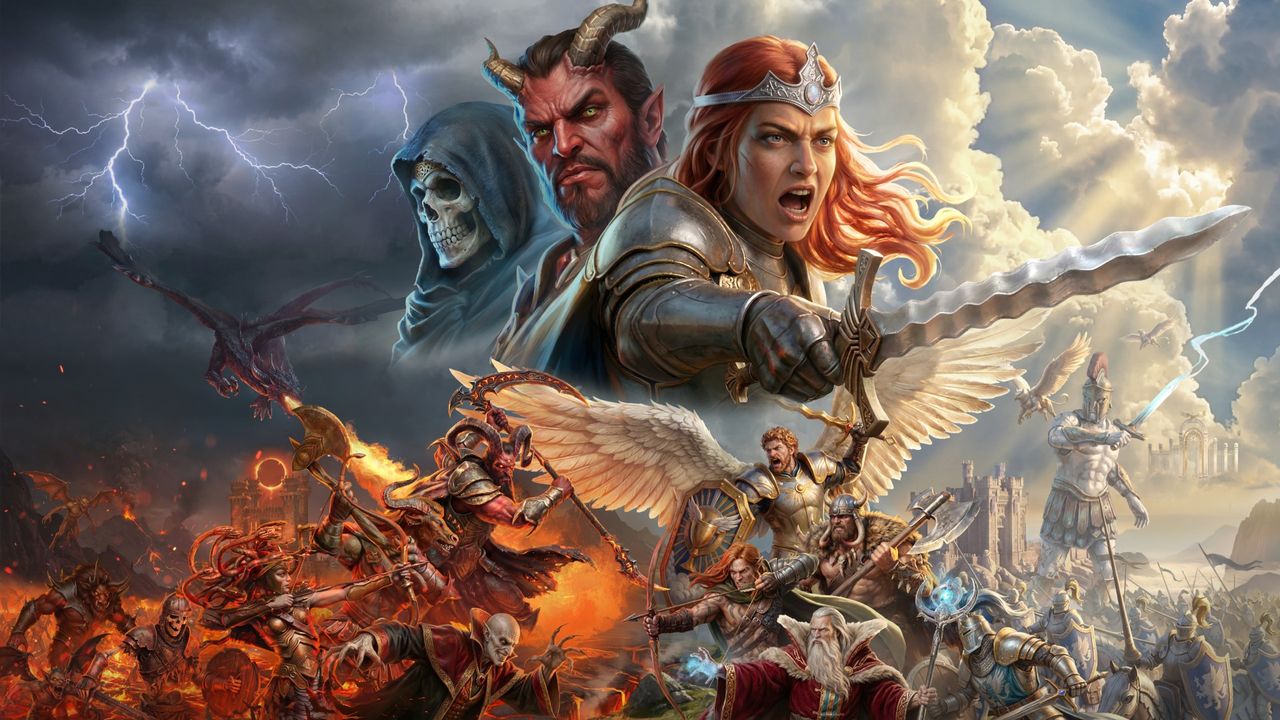
The tactical depth becomes increasingly apparent as battles grow more complex. Hero characters gain experience and levels, unlocking powerful abilities and spells that can turn the tide of seemingly impossible encounters. The original game featured over 100 different creature types across nine distinct factions, and this remake faithfully preserves that incredible variety while updating the visual presentation to modern standards. Each faction plays distinctly—the undead Necropolis faction can raise fallen enemies as skeletons, the Rampart faction excels with swift elven units and powerful dragons, while the Inferno faction unleashes demons and devils upon unsuspecting foes. This diversity ensures that no two campaigns feel identical, contributing to the game’s legendary replayability.
The Underground Depths and Catastrophic Downfall
Everything proceeds as smooth sailing right up until I uncover a mysterious gateway leading underground—revealing another entire layer of the map to explore, conquer, and fight over. This dual-layer map design was revolutionary when introduced in the original game, effectively doubling the playable area and adding strategic considerations about controlling access points between the surface and subterranean realms. Not that there’s much fighting left to be done in my particular campaign, unfortunately. I recruit a necromancer hero and send her to the underground depths, hoping to find weaker units to kill and raise as undead servants, only to be immediately accosted by a far stronger enemy necromancer commanding five—yes, five—ghost dragons. My own hero melts like fat off bone under their spectral assault, and with the rest of my forces committed to fighting Thorgrim on the surface—and all recruitment pools completely bare from having recently bolstered my primary army—my cities are left utterly defenseless against this unexpected subterranean threat.
My preview session ends just as the gateway spills its undead guts onto the surface world. The writing is unmistakably on the wall—in a few more in-game days, there would be nothing but ash and spectral scales where my fledgling civilization once stood. This brutal lesson in strategic overextension serves as a perfect reminder of why the original game demanded respect from even experienced strategy veterans. The AI opponents in Heroes of Might and Magic 3 were notoriously competent, and this remake appears to preserve that challenging nature while introducing modern conveniences.
Modern Technology Meets Timeless Design
Coming into HoMM 3 Remake completely blind, I find myself thoroughly hooked on its high-fantasy flavor and no-frills strategic gameplay. However, some changes are specifically designed for long-time fans who have been playing since 1999. The technology behind HoMM 3 Remake is remarkably capable of replicating existing and community-made maps from the original game, switching their 20th-century pixelated graininess for lush modern visuals without losing each tile’s functionality. Quality of life tweaks like attack damage previews, improved pathfinding displays, and streamlined interface elements make the experience more accessible without compromising the strategic depth that made the original legendary. The development team clearly understood their assignment: preserve what made the original special while removing friction that modern players would find frustrating.
It represents a welcome surprise to see HoMM 3 given a new lease of life so soon after the runaway success of Heroes of Might and Magic: Olden Era, which proved that appetite for this style of gameplay remains strong among contemporary audiences. The turn-based strategy genre has experienced something of a renaissance in recent years, with titles like Civilization VI, Old World, and various tactical RPGs demonstrating that thoughtful, methodical gameplay can thrive alongside faster-paced alternatives. With the series’ core proving remarkably timeless, HoMM 3 Remake seems likely to bring even more new fans into the fold—myself enthusiastically included. For those who missed the original release, this remake offers a perfect entry point into one of strategy gaming’s most celebrated franchises.
Expert Opinion: The timing of Heroes of Might and Magic 3 Remake couldn’t be more strategic, capitalizing on renewed interest in classic turn-based strategy while the success of Olden Era has primed the audience. This remake demonstrates that faithful preservation of core gameplay mechanics, combined with thoughtful modernization of presentation and quality-of-life features, represents the gold standard for bringing beloved classics to new generations. Expect this release to reignite competitive community interest and potentially spawn a new wave of content creators discovering the franchise for the first time.